Every year, enterprises lose an estimated 1,200 development hours per engineer managing infrastructure manually—time that could be spent building features that drive revenue. For CIOs and CTOs leading digital transformation initiatives, this inefficiency represents not just wasted resources, but a competitive disadvantage in markets where speed to market determines success.
DevOps has evolved from a buzzword to a business imperative, yet many organizations struggle with legacy infrastructure that exists outside their automation pipelines. Enter Terraform Import: a critical capability that bridges the gap between manual infrastructure and automated DevOps workflows. This capability becomes exponentially more powerful when paired with modern automation platforms.
In this comprehensive guide, we’ll explore how Terraform Import works, why it’s essential for modern DevOps operations, and how platforms like QuickInfra’s transform this complex process into a streamlined workflow. Whether you’re managing hundreds of cloud resources or planning a complete infrastructure overhaul, understanding Terraform Import is your first step toward achieving the 65% cost savings and 4x deployment acceleration that industry leaders are already experiencing.
Table of Contents
ToggleUnderstanding Terraform Import: The Foundation of Modern DevOps
The Infrastructure Management Challenge
Technology leaders today face a universal challenge: reconciling decades of infrastructure decisions with modern DevOps practices. Your organization likely has hundreds—or thousands—of cloud resources created through AWS consoles, Azure portals, manual scripts, or legacy automation tools. These resources represent significant business value but exist outside your Infrastructure-as-Code (IaC) framework.
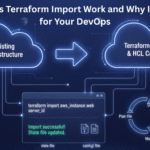
Terraform Import Work addresses this critical gap. At its core, Terraform import is the mechanism that allows you to bring existing infrastructure resources under Terraform management without destroying and recreating them. Think of it as a reconciliation process: you’re telling Terraform, “This resource already exists in my cloud environment; please start tracking and managing it.”
The manual approach to managing infrastructure creates several costly bottlenecks:
- Configuration drift where production infrastructure diverges from documented standards
- Audit and compliance gaps due to resources existing outside version control systems
- Knowledge silos where only specific engineers understand certain infrastructure components
- Deployment delays caused by manual verification and approval processes
- Security vulnerabilities from inconsistent application of security policies
Research from leading analyst firms indicates that organizations with mature DevOps practices experience 46 times more frequent code deployments and 440 times faster lead time from commit to deploy. Yet achieving this maturity requires bringing all infrastructure under consistent, automated management—precisely where Terraform Import becomes mission-critical.
How Terraform Import Actually Works
Terraform Import Work follows a methodical process that technology leaders should understand when evaluating infrastructure automation strategies:
1. Resource Identification and Mapping The import process begins by identifying the exact resource in your cloud provider (AWS, Azure, GCP, or Oracle Cloud) using its unique identifier. For example, an EC2 instance might have an ID like i-0b9be609418aa0609. Terraform needs this precise identifier to establish the connection between your configuration code and the actual running resource.
2. State File Integration Once identified, Terraform adds the resource to its state file—the single source of truth that tracks all managed infrastructure. This state file becomes the foundation for all future automation, enabling Terraform to calculate what changes need to be applied to achieve your desired infrastructure configuration.
3. Configuration Alignment After importing, you must write Terraform configuration code that matches the current state of the imported resource. This is where many manual import processes become error-prone and time-consuming. Every attribute—from instance types and security groups to tags and IAM roles—must be accurately represented in code.
4. Drift Detection and Reconciliation Running terraform plan after import reveals any discrepancies between your configuration and the actual resource state. These “drifts” must be resolved to prevent Terraform from attempting to modify or replace resources during subsequent operations.
QuickInfra’s platform revolutionizes this traditionally manual process through intelligent automation. Instead of spending hours writing configuration code and hunting down resource attributes, QuickInfra’s auto-generates Terraform scripts that perfectly match your existing infrastructure, reducing Terraform Import Work from days to minutes.
The Business Impact of Import Capabilities
For decision-makers evaluating DevOps automation platforms, the efficiency of the import process directly impacts your digital transformation timeline and ROI. Consider these real-world scenarios:
Scenario 1: M&A Infrastructure Integration When your company acquires another organization, you inherit their entire cloud infrastructure. Without efficient import capabilities, integrating this infrastructure can take months. QuickInfra’s one-click CI/CD setup and automated infrastructure provisioning enable you to bring acquired infrastructure under management in days, not quarters.
Scenario 2: Compliance-Driven Documentation New regulatory requirements demand complete documentation and version control of all infrastructure. Manual documentation of hundreds of resources is prohibitively expensive. Importing resources into Terraform with QuickInfra’s automated approach creates compliance-ready documentation as a byproduct of your normal DevOps workflow.
Scenario 3: Legacy Modernization Your team built critical infrastructure over five years using various methods. Now you need consistent automation. QuickInfra’s Infrastructure-as-Code implementation approach imports existing resources while simultaneously establishing the automation foundation for future growth, achieving the 4x faster launch times that modern businesses require.

Strategies for Successful DevOps Implementation with Terraform Import
Planning Your Import Strategy
Successful infrastructure import isn’t just a technical exercise—it’s a strategic initiative that requires careful planning and stakeholder alignment. Technology leaders should consider these key questions when designing their import approach:
What is the scope of your import initiative? Are you importing a single application’s infrastructure, an entire business unit’s resources, or your complete multi-cloud environment? QuickInfra’s multi-cloud support for AWS, Azure, GCP, and Oracle Cloud enables you to execute unified import strategies across your entire technology estate.
What is your risk tolerance for infrastructure changes? Some resources are mission-critical and cannot tolerate any downtime. Others might benefit from optimization during the import process. Understanding this spectrum helps you prioritize which resources to import first and which might be candidates for replacement with more modern alternatives.
How will you handle dependencies between resources? Cloud infrastructure exists in complex dependency graphs. A database depends on a VPC, which depends on security groups, which depend on IAM roles. QuickInfra’s intelligent infrastructure provisioning automatically maps these dependencies, preventing the cascade failures that plague manual import efforts.
Implementing Infrastructure-as-Code Through Import
The transition from manual infrastructure management to Infrastructure-as-Code represents a fundamental shift in how your organization operates. This transition doesn’t happen overnight, but strategic use of import capabilities accelerates the journey dramatically.
Phase 1: Assessment and Inventory Begin by cataloging your existing infrastructure across all cloud providers. QuickInfra’s platform provides automated discovery capabilities that identify resources and their relationships, creating a comprehensive inventory without manual effort. This inventory becomes your import roadmap.
Phase 2: Prioritized Import Execution Not all infrastructure needs to be imported simultaneously. Start with non-production environments or isolated application stacks. This phased approach allows your team to develop expertise and refine processes before tackling mission-critical production systems. QuickInfra’s 100% secure and compliant infrastructure ensures that even your initial imports meet enterprise security standards.
Phase 3: Optimization and Standardization Once resources are under Terraform management, you can leverage DevOps best practices to optimize configurations. QuickInfra’s auto-created Terraform and Ansible scripts provide a solid foundation, but the real value comes from iterative improvement—right-sizing instances, implementing consistent tagging strategies, and applying security policies uniformly.
Case Study: Financial Services Firm Accelerates Cloud Adoption
A mid-sized financial services company with $2B in assets faced a common challenge: 300+ AWS resources created over three years existed outside their DevOps pipeline. Compliance requirements demanded complete documentation and version control, but their DevOps team estimated 6 months to manually import and document everything.
By implementing QuickInfra’s platform, they achieved:
- Complete import in 3 weeks instead of 6 months, using automated Terraform script generation
- 65% reduction in infrastructure management costs through elimination of manual processes
- Zero security incidents during import, thanks to built-in DevSecOps controls
- 4x faster deployment of new features after import completion, enabled by one-click CI/CD setup
The CFO noted that the project paid for itself within 45 days through reduced contractor costs and improved developer productivity. More importantly, they achieved SOC 2 compliance six months ahead of schedule, opening new market opportunities.
Actionable Tactics for Import Success
Technology leaders can accelerate their import initiatives by following these proven tactics:
1. Start with Read-Only Operations Before making any changes, import resources and run terraform plan to understand the current state. QuickInfra’s platform highlights any configuration drifts, allowing you to address discrepancies before applying changes. This risk-mitigation approach prevents the costly mistakes that plague manual Terraform Import Work.
2. Implement State File Management Early Your Terraform state file is the single source of truth for managed infrastructure. Store it in a secure, shared backend (S3 with DynamoDB locking, Azure Storage, or Terraform Cloud) from day one. QuickInfra’s automated infrastructure provisioning includes state file backend configuration, eliminating this common oversight.
3. Leverage Workspaces for Environment Isolation Use Terraform workspaces to separate development, staging, and production imports. This isolation prevents accidental changes to production while enabling teams to experiment safely. QuickInfra’s multi-cloud support extends workspace benefits across your entire cloud portfolio.
4. Automate Import Command Generation Manually writing import commands for hundreds of resources is error-prone. QuickInfra’s platform generates import commands automatically, ensuring accuracy and saving hundreds of hours. The auto-created Terraform scripts include all necessary import statements, ready for execution.
5. Establish Continuous Drift Detection Import is not a one-time activity. Resources can drift from their defined configuration due to manual changes, automated scaling, or cloud provider updates. Implement continuous monitoring that detects drift and alerts your team. QuickInfra’s platform includes automated drift detection as part of its comprehensive DevOps automation suite.
Tools and Technologies That Enhance DevOps Automation

The Modern DevOps Technology Stack
Successful DevOps implementations in 2025 require integration of multiple technologies working in concert. While Terraform provides the foundation for Infrastructure-as-Code, platforms like QuickInfra’s orchestrate these technologies into cohesive, automated workflows.
Infrastructure-as-Code Foundation Terraform remains the industry standard for declarative infrastructure management, but raw Terraform requires significant expertise. Ansible complements Terraform by handling configuration management and application deployment. QuickInfra’s generates both Terraform and Ansible scripts automatically, providing teams with production-ready automation without the typical learning curve.
CI/CD Pipeline Integration Continuous Integration and Continuous Deployment pipelines transform how organizations deliver software. However, setting up robust CI/CD pipelines traditionally requires weeks of configuration. QuickInfra’s one-click CI/CD setup eliminates this barrier, allowing teams to move from planning to production deployment in hours rather than weeks.
Security and Compliance Automation DevSecOps integrates security into every stage of the development lifecycle. Manual security reviews create bottlenecks that slow deployment velocity. QuickInfra’s built-in security and compliance features automate vulnerability scanning, policy enforcement, and compliance reporting, ensuring your infrastructure maintains security posture without sacrificing speed.
QuickInfra’s Integration Advantages
Technology leaders evaluating DevOps platforms should assess how well solutions integrate with existing business processes and technical environments. QuickInfra’s platform excels in several critical integration dimensions:
Multi-Cloud Native Architecture Your business likely uses multiple cloud providers—AWS for compute, Azure for enterprise applications, GCP for data analytics, Oracle for databases. Managing infrastructure across these platforms traditionally requires separate tools and teams. QuickInfra’s unified multi-cloud support enables consistent DevOps practices across AWS, Azure, GCP, and Oracle Cloud, reducing complexity and improving team efficiency.
Existing Tool Integration QuickInfra’s doesn’t force you to abandon your current investments. The platform integrates with popular version control systems (GitHub, GitLab, Bitbucket), monitoring solutions (Datadog, New Relic, Prometheus), and security tools (Aqua, Snyk, Prisma Cloud). This integration preserves your existing DevOps toolchain while adding powerful automation capabilities.
Enterprise System Connectivity For large organizations, DevOps platforms must connect with enterprise systems like ServiceNow for change management, Jira for project tracking, and corporate SSO for authentication. QuickInfra’s supports these integrations out of the box, ensuring DevOps automation aligns with corporate governance requirements.
ROI Considerations and Metrics
CTOs and CIOs require concrete ROI justification for technology investments. DevOps automation through platforms like QuickInfra’s delivers measurable returns across multiple dimensions:
Direct Cost Savings (65% average reduction)
- Reduced infrastructure management overhead through automation
- Lower contractor and consulting costs for DevOps implementation
- Decreased cloud spending through resource optimization and right-sizing
- Elimination of redundant tools replaced by unified platforms
Time-to-Market Acceleration (4x faster)
- Faster feature deployment enabling competitive advantage
- Reduced time from concept to production deployment
- Accelerated response to market opportunities and customer demands
- Shorter feedback cycles improving product-market fit
Risk Mitigation
- Reduced security vulnerabilities through automated compliance checking
- Decreased outage frequency due to consistent infrastructure management
- Lower audit costs with automated documentation and version control
- Minimized configuration drift preventing costly incidents
Developer Productivity (4x improvement)
- Engineers focus on feature development instead of infrastructure management
- Reduced context switching between development and operations tasks
- Faster onboarding of new team members with standardized processes
- Improved job satisfaction leading to better retention
A Fortune 500 technology company calculated that QuickInfra’s platform delivered $3.2M in annual value through a combination of reduced operational costs ($1.8M), faster time-to-market revenue gains ($1.1M), and avoided security incident costs ($300K). The platform paid for itself in under 60 days.
Security and Compliance in Automated DevOps
For regulated industries—financial services, healthcare, government—security and compliance are non-negotiable. Traditional DevOps implementations often treat security as an afterthought, creating costly remediation cycles. QuickInfra’s built-in DevSecOps controls embed security from day one.
Automated Security Controls
- Infrastructure hardening applied automatically during provisioning
- Encryption enforced for data at rest and in transit
- Network segmentation and least-privilege access implemented by default
- Vulnerability scanning integrated into CI/CD pipelines
Compliance Framework Support QuickInfra’s platform includes pre-built compliance templates for major frameworks:
- SOC 2 Type II
- ISO 27001
- HIPAA
- PCI-DSS
- GDPR
- FedRAMP
These templates ensure that imported infrastructure and newly provisioned resources meet regulatory requirements without manual configuration. The 100% secure and compliant infrastructure promise isn’t marketing—it’s built into the platform architecture.
Audit and Reporting Automated audit logging captures every infrastructure change with full attribution and timestamps. This audit trail satisfies compliance requirements while providing operational visibility. QuickInfra’s generates compliance reports automatically, reducing the burden on your security and compliance teams.
Transforming Your DevOps Practice: The Path Forward
Building Your Implementation Roadmap
Technology leaders ready to transform their DevOps practices need a clear implementation roadmap. Based on hundreds of successful deployments, here’s the proven path to DevOps automation excellence with QuickInfra’s:
Month 1: Assessment and Planning
- Inventory existing infrastructure across all cloud providers
- Identify import priorities based on business criticality and compliance requirements
- Define success metrics aligned with business objectives
- Establish governance framework for Infrastructure-as-Code
- Schedule QuickInfra’s demo to understand platform capabilities
Month 2: Pilot Implementation
- Select pilot project (recommend non-production environment or isolated application)
- Import pilot infrastructure using QuickInfra’s automated capabilities
- Implement one-click CI/CD setup for pilot applications
- Train core team on Infrastructure-as-Code best practices
- Measure pilot results against baseline metrics
Month 3: Expansion and Optimization
- Expand import scope to additional applications and environments
- Optimize imported infrastructure using insights from automated analysis
- Implement automated drift detection and remediation
- Establish self-service infrastructure provisioning for development teams
- Document processes and create runbooks
Month 4-6: Enterprise Rollout
- Scale implementation across organization
- Migrate production workloads to automated DevOps workflows
- Implement advanced features (multi-cloud orchestration, compliance automation)
- Establish Centers of Excellence for DevOps best practices
- Measure and report ROI to stakeholders
Key Success Factors
Organizations that achieve exceptional results from DevOps automation share common characteristics:
Executive Sponsorship Successful transformations have CIO or CTO-level sponsorship ensuring resources and attention. DevOps automation affects multiple teams and requires organizational change management that only executive leaders can drive effectively.
Team Enablement Invest in training and enablement for your engineering teams. While QuickInfra’s dramatically simplifies Terraform Import Work and DevOps automation, teams still need to understand Infrastructure-as-Code principles and best practices. Plan for initial training and ongoing skill development.
Incremental Approach Avoid “big bang” implementations. The most successful organizations take incremental approaches, learning from each phase and adapting their strategies. QuickInfra’s flexibility supports this phased approach, allowing you to start small and scale based on demonstrated value.
Metrics-Driven Culture Establish clear metrics from day one and review them regularly. Track deployment frequency, lead time, change failure rate, and mean time to recovery. These metrics provide objective evidence of improvement and help justify continued investment in DevOps automation.
Questions Technology Leaders Should Ask
As you evaluate your organization’s DevOps maturity and automation needs, consider these strategic questions:
- How much time do your engineers spend on infrastructure management versus feature development? If the answer is more than 20%, automation will deliver significant productivity gains.
- Can you deploy a code change to production in under an hour? If not, pipeline automation should be a priority.
- Do you have complete visibility into all cloud resources across your organization? Lack of visibility indicates infrastructure sprawl that import capabilities can address.
- What is your current change failure rate for infrastructure modifications? High failure rates indicate that manual processes need automation assistance.
- How long does it take to provision a new environment for a development team? If the answer is measured in days or weeks, self-service infrastructure provisioning will dramatically accelerate your teams.
- Are you confident that all your infrastructure meets security and compliance requirements? If there’s any uncertainty, automated compliance checking is essential.
- What percentage of infrastructure changes go through version control? If it’s less than 100%, you’re missing the benefits of Infrastructure-as-Code.

Conclusion: Accelerating Your DevOps Journey
Terraform Import Work represents more than a technical capability—it’s the bridge between legacy infrastructure management and modern DevOps automation. For technology leaders navigating digital transformation, understanding and leveraging import capabilities accelerates the journey from manual, error-prone processes to automated, reliable infrastructure management.
The business case for DevOps automation is compelling: 65% cost savings, 4x faster launches, and 100% secure, compliant infrastructure from day one. These aren’t aspirational goals—they’re results that organizations achieve when they combine Terraform’s power with platforms like QuickInfra’s that eliminate complexity and accelerate implementation.
Your infrastructure represents years of investment and accumulated business knowledge. The prospect of managing it through modern DevOps practices shouldn’t require starting from scratch or accepting months of disruption. Strategic use of Terraform import, powered by intelligent automation, allows you to preserve existing investments while gaining the agility, security, and cost efficiency that modern businesses demand.
The question isn’t whether to embrace DevOps automation—competitors who move faster will force your hand. The question is how quickly you can execute the transformation. With the right platform and approach, you can achieve in months what previously took years.
Take the Next Step
Ready to transform your DevOps practice and achieve the productivity gains that leading organizations already enjoy? QuickInfra’s makes it easy to get started:
- Schedule a personalized demo to see how QuickInfra’s handles your specific infrastructure challenges
- Start a free trial to experience automated Terraform Import Work and one-click CI/CD setup firsthand
- Consult with QuickInfra’s experts to design your custom implementation roadmap
- Download our ROI calculator to quantify the business case for your organization
Your journey to world-class DevOps automation starts with a single step. Contact QuickInfra’s today and discover how we help technology leaders like you get more from their cloud, Kubernetes, and Terraform investments—with 90% less manual effort and results that transform your business competitiveness.
Visit [www.quickinfra.com] or email [sales@quickinfra.com] to connect with our team. Your infrastructure deserves better than manual management. Your teams deserve tools that amplify their capabilities. Your business deserves the competitive advantage that DevOps automation delivers.
Let’s build the future of your infrastructure—together.