Every year, US companies waste over 2,000 development hours per team manually managing infrastructure configurations—time that could be spent building revenue-generating features instead of wrestling with configuration drift and resource reconciliation. For CTOs and DevOps leaders, this isn’t just an operational inefficiency; it’s a competitive disadvantage that directly impacts your bottom line and market responsiveness.
The challenge intensifies when organizations need to bring existing cloud resources under Infrastructure-as-Code management. This is where understanding Terraform import becomes critical for your DevOps transformation. Whether you’re migrating from manual cloud console management, inheriting infrastructure from acquisitions, or recovering from state file corruption, Terraform import serves as the bridge between your current infrastructure reality and your automated DevOps future.
In this comprehensive guide, we’ll explore how Terraform import works, why it matters for modern DevOps practices, and how platforms like QuickInfra’s transform what traditionally required weeks of manual effort into automated processes. You’ll discover strategies that reduce manual infrastructure management by 90% and accelerate your deployment cycles by 4x—turning DevOps from a bottleneck into a competitive advantage.
Table of Contents
ToggleUnderstanding Terraform Import: The Foundation of Infrastructure Automation
What Is Terraform Import and Why DevOps Teams Need It
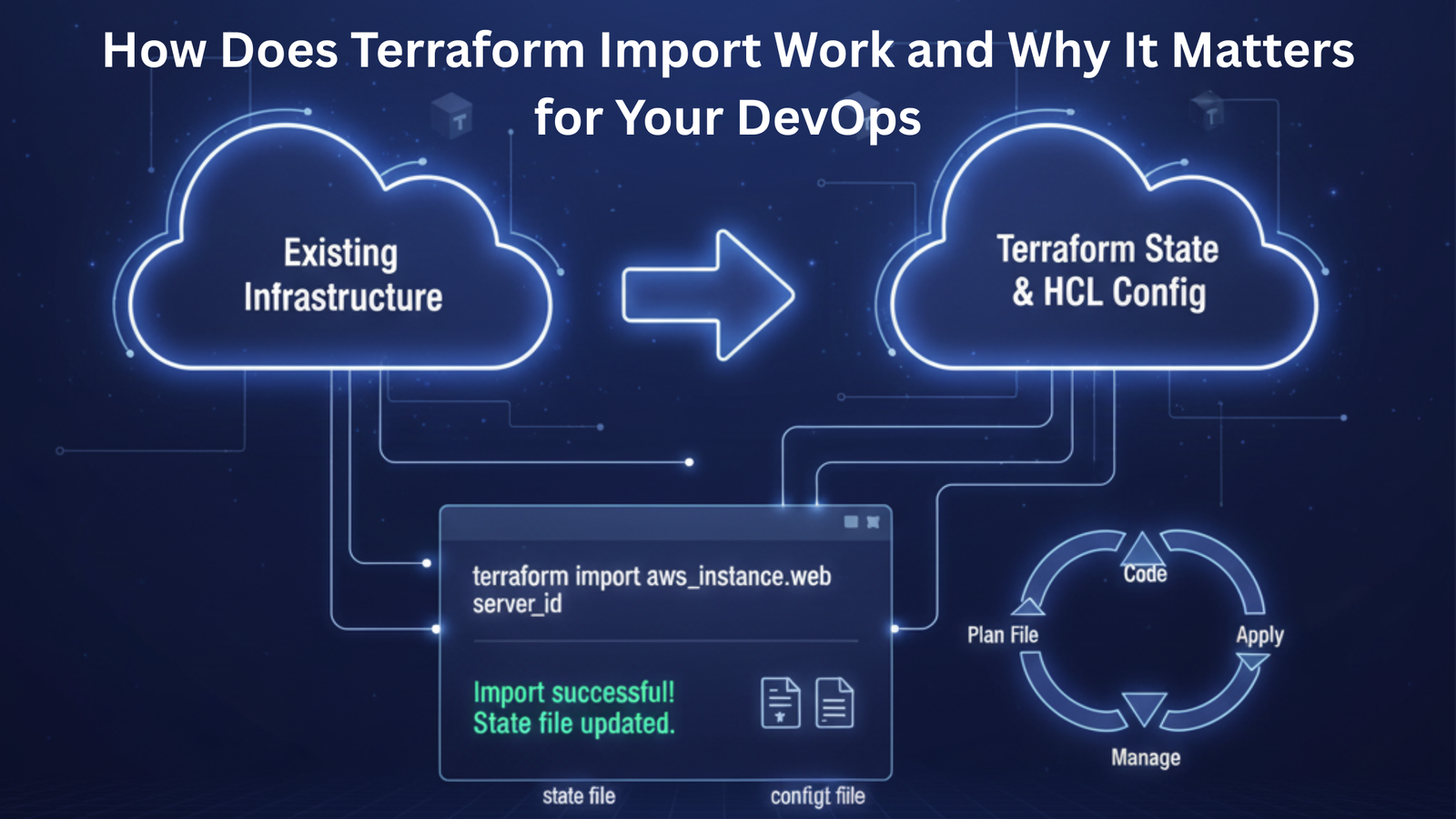
Terraform import is a critical command that enables DevOps teams to bring existing cloud resources under Terraform management without recreating them. Think of it as the onboarding process for your infrastructure—taking resources that were created manually, through other tools, or outside your current Infrastructure-as-Code workflow, and integrating them into your Terraform state management system.
For decision-makers evaluating what DevOps is and how it can transform their operations, Terraform import represents a crucial capability. It allows your organization to adopt Infrastructure-as-Code incrementally rather than requiring a risky “big bang” migration that could disrupt production services. This incremental approach is exactly what devops and cloud integration should look like—minimizing risk while maximizing automation benefits.
The core scenarios where Terraform import becomes essential include:
- Legacy Infrastructure Modernization: Bringing manually created AWS, Azure, GCP, or Oracle cloud resources under automated management
- Mergers and Acquisitions: Integrating acquired companies’ infrastructure into your standardized DevOps workflows
- Disaster Recovery: Reconstructing Terraform state files after corruption or accidental deletion
- Team Transition: Moving from other infrastructure tools like CloudFormation or manual scripts to Terraform
- Refactoring at Scale: Restructuring your Terraform modules and configurations as your infrastructure grows
The manual approach to Terraform import traditionally requires extensive technical expertise, hours of configuration writing, and multiple iterations to achieve drift-free state. This is where modern DevOps automation platforms transform the equation—QuickInfra’s auto-generated Terraform scripts eliminate 90% of this manual work, allowing your team to focus on innovation rather than configuration reconciliation.
How Terraform Import Work: The Technical Process Explained
Understanding how Terraform import work at a technical level helps technology leaders make informed decisions about their DevOps automation strategy. The terraform import process involves several critical steps that must be executed precisely to avoid infrastructure disruption.
The Traditional Terraform Import Workflow:
Step 1: Resource Identification Your DevOps team must identify the exact resource IDs from your cloud provider. For an AWS EC2 instance, this might be i-0b9be609418aa0609. For an Azure virtual machine, it could be a full resource ID path. This identification phase alone can consume hours when dealing with complex, interconnected resources.
Step 2: Configuration Creation Before running any terraform import example, you must manually write the Terraform configuration block that matches your existing resource. This requires deep knowledge of Terraform resource schemas and the ability to translate real-world infrastructure into declarative code. A single missed attribute can cause Terraform to plan destructive changes.
Step 3: Import Execution Running the actual Terraform import command maps your written configuration to the real resource. The syntax varies by resource type, but follows this pattern:
terraform import aws_instance.myvm i-0b9be609418aa0609Step 4: State Reconciliation After import, you must run terraform plan to identify drift between your configuration and the actual resource state. This typically reveals dozens of missing attributes that must be added to your configuration file to achieve a clean plan with no changes.
Step 5: Iterative Refinement Most terraform import resources require multiple iterations of updating configuration, running plans, and refining code until you achieve complete alignment between your Terraform configuration and real-world infrastructure.
This five-step process, when done manually, can take experienced DevOps engineers 2-4 hours per resource for complex infrastructure components. Multiply this across hundreds or thousands of resources, and you’re looking at weeks or months of engineering time—time that QuickInfra’s automated infrastructure provisioning reduces to minutes through intelligent resource discovery and auto-created Terraform scripts.

Current Challenges in DevOps Implementation and Infrastructure Management
The Hidden Costs of Manual DevOps Processes
Technology leaders often underestimate the true cost of manual DevOps operations until they calculate the total impact on their development velocity and operational expenses. Recent industry data reveals that companies without proper DevOps automation spend an average of $287,000 annually per 10-person engineering team on infrastructure management tasks that could be automated.
The compounding challenges include:
Resource Discovery Bottlenecks: When your infrastructure spans multiple AWS accounts, Azure subscriptions, or GCP projects, simply inventorying what exists becomes a weeks-long project. Your DevOps teams spend valuable time clicking through cloud consoles, running CLI commands, and maintaining spreadsheets of resources—none of which creates business value.
Configuration Drift Crisis: Without Infrastructure-as-Code management, your production infrastructure diverges from documentation within days. Emergency fixes applied directly to cloud resources never make it back into your version control system. Six months later, nobody knows why that security group rule exists or whether it’s still needed. This drift creates security vulnerabilities, compliance gaps, and fear of making any infrastructure changes.
Scaling Paralysis: As your business grows, manual infrastructure management becomes exponentially more complex. What worked for 10 microservices collapses under the weight of 100. Your DevOps team becomes a bottleneck, with developers waiting days or weeks for environment provisioning. This is precisely what devops and cloud strategies should eliminate, not create.
Knowledge Silos and Bus Factor: When infrastructure knowledge lives in one senior engineer’s head rather than in automated, documented code, your organization faces existential risk. Vacation time becomes a crisis. Turnover becomes catastrophic. The “bus factor” keeps CTOs awake at night.
The financial impact extends beyond labor costs. Companies with manual DevOps processes deploy 10x less frequently than competitors with automated pipelines, directly impacting their ability to respond to market opportunities and customer needs. When your deployment cycle takes weeks instead of hours, every feature becomes a strategic decision rather than an experimental iteration.
Why Traditional Terraform Import Approaches Create More Problems
Even when organizations recognize the need for Infrastructure-as-Code and attempt to implement Terraform import resources into their workflows, the traditional manual approach introduces new categories of problems that can derail DevOps transformation initiatives.
Error-Prone Manual Configuration: The terraform import command doesn’t generate configuration files automatically in older Terraform versions. Your engineers must manually reconstruct the configuration by examining the real resource through cloud consoles or APIs, then translating that into Terraform’s declarative syntax. A single typo in an AMI ID or subnet reference can cause Terraform to plan the destruction and recreation of production resources—a risk no CTO should accept.
Dependency Resolution Nightmare: Real-world infrastructure isn’t isolated resources—it’s interconnected webs of dependencies. That EC2 instance depends on a security group, which references a VPC, which contains subnets spanning multiple availability zones. Each terraform import module operation requires understanding and documenting these relationships. Missing a dependency means incomplete state files and unpredictable Terraform behavior.
Resource ID Complexity: Some cloud resources require multiple identifiers for import. An AWS autoscaling policy needs both the scaling policy name and the autoscaling group name. IAM roles attached to multiple policies require separate imports for each attachment. Load balancer listeners require compound identifiers. Your DevOps team needs cloud provider expertise across AWS, Azure, GCP, and Oracle to handle these variations correctly.
The Time-to-Value Gap: By the time your team completes a manual Terraform import project—identifying resources, writing configurations, importing state, resolving drift, testing changes, and documenting the process—competitive pressure may have already shifted your priorities. Projects that should take days stretch into quarters, and the ROI calculation becomes increasingly difficult to justify to your CFO.
This is exactly why forward-thinking technology leaders are moving beyond manual terraform import example tutorials toward automated DevOps platforms. QuickInfra’s one-click CI/CD setup and automated infrastructure provisioning eliminate these manual bottlenecks entirely, letting your team achieve in hours what traditionally required months of specialized engineering effort.
Innovative Strategies for Modern DevOps Automation and Terraform Import
Transforming Terraform Import Through Automation
The next generation of DevOps automation doesn’t just make terraform import work faster—it fundamentally reimagines how organizations approach Infrastructure-as-Code adoption. Instead of treating infrastructure import as a manual engineering project, leading companies are leveraging automated discovery, intelligent configuration generation, and continuous reconciliation to eliminate traditional pain points entirely.
Automated Resource Discovery and Mapping: Modern DevOps platforms scan your entire cloud footprint across AWS, Azure, GCP, and Oracle environments, automatically identifying every resource, understanding dependencies, and building a comprehensive infrastructure graph. This eliminates weeks of manual inventory work and ensures nothing gets overlooked in your terraform import resources strategy.
Intelligent Configuration Generation: Rather than requiring DevOps engineers to manually write terraform import block configurations by studying resource schemas and API documentation, automated platforms generate syntactically correct, drift-free Terraform code instantly. QuickInfra’s auto-created Terraform & Ansible scripts leverage AI-powered analysis of your existing infrastructure to produce production-ready configuration files that would take senior engineers hours to create manually.
Continuous Compliance and Drift Detection: Once resources are imported, maintaining alignment between your Terraform state and actual infrastructure requires ongoing vigilance. Automated platforms provide real-time drift detection, security policy enforcement, and automatic remediation—transforming terraform import from a one-time migration into an ongoing governance capability that ensures your infrastructure remains 100% secure and compliant.
Multi-Cloud Terraform Import at Scale: For enterprises operating across multiple cloud providers, coordinating terraform import module operations requires orchestration across different provider APIs, resource naming conventions, and state management strategies. Platforms designed for multi-cloud operations handle these complexities transparently, giving technology leaders a unified view of infrastructure regardless of underlying provider.
The productivity impact is transformational. Where traditional manual approaches require 2-4 hours per resource for experienced engineers, automated platforms reduce this to minutes—achieving the 4x faster launches and 90% reduction in manual effort that QuickInfra’s delivers to clients across industries.
Real-World Case Study: Enterprise Terraform Import Transformation
Consider the experience of a mid-market financial services company that recently underwent DevOps transformation. With 800+ AWS resources created over five years through manual console operations, CloudFormation templates, and various automation scripts, they faced a classic infrastructure management crisis. No single source of truth existed. Compliance audits required weeks of manual verification. Disaster recovery planning was guesswork.
The Challenge: Their DevOps team estimated 6-8 months to manually import all resources into Terraform, write configurations, resolve dependencies, and achieve drift-free state. During this period, they’d need to freeze infrastructure changes—impossible for a growing business. The project seemed too risky and expensive to justify.
The Automated Solution: By implementing QuickInfra’s automated infrastructure provisioning, the company transformed their timeline from months to weeks. The platform automatically discovered all 800+ resources, mapped dependencies, generated Terraform configurations, and created a complete Infrastructure-as-Code foundation in under three weeks—including testing and validation.
The Business Impact:
- Time Savings: 85% reduction in engineering hours compared to manual approach
- Risk Reduction: Zero production incidents during migration due to automated validation
- Cost Optimization: Discovered $47,000 in annual cloud waste through automated analysis
- Compliance Acceleration: Achieved SOC 2 compliance requirements 4x faster through automated DevSecOps controls
- Developer Productivity: Engineering teams now provision new environments in 10 minutes instead of 2 weeks
This case study demonstrates what devops is truly meant to accomplish—transforming infrastructure management from a manual, error-prone burden into an automated competitive advantage. The company now deploys daily instead of monthly, responds to security threats in hours instead of weeks, and scales infrastructure in minutes instead of days.
The terraform import example here isn’t just about migrating resources—it’s about fundamentally changing how technology organizations operate. When CTOs ask “what is the devops transformation ROI?”, this is the answer: measurable improvements in deployment frequency, mean time to recovery, change failure rate, and lead time for changes—the four key metrics that distinguish high-performing technology organizations from their competitors.
Tools and Technologies Revolutionizing DevOps Automation
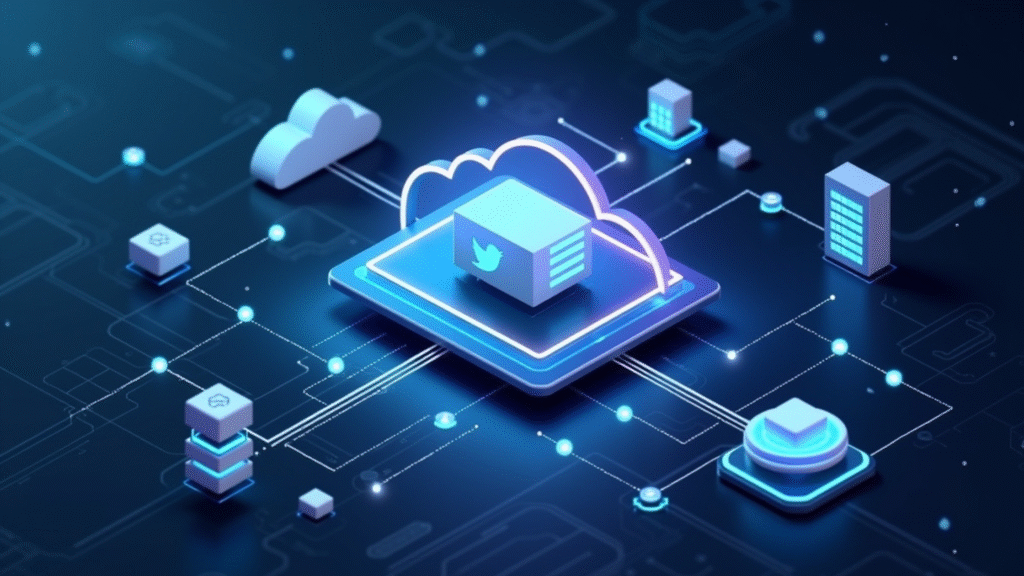
The Modern DevOps Automation Technology Stack
Understanding what tools and platforms truly deliver on DevOps automation promises requires looking beyond marketing claims to examine actual architectural capabilities and integration patterns. For technology leaders evaluating terraform import solutions and broader DevOps transformation, several key technology categories define modern infrastructure automation.
Infrastructure-as-Code Platforms: At the foundation, tools like Terraform and Ansible provide the declarative language for defining infrastructure. However, the value multiplier comes from platforms that generate and manage these configurations automatically. QuickInfra’s approach of auto-creating Terraform & Ansible scripts based on your existing infrastructure and best practices eliminates the traditional learning curve and configuration burden.
Automated CI/CD Orchestration: While Jenkins, GitLab CI, and GitHub Actions provide build and deployment pipeline capabilities, configuring these tools correctly for infrastructure deployments traditionally requires weeks of specialized expertise. Modern DevOps platforms offer one-click CI/CD setup that implements security scanning, automated testing, approval workflows, and deployment orchestration out of the box—turning what traditionally took 40+ hours of DevOps engineering into a 10-minute configuration process.
Multi-Cloud Management Layers: As organizations adopt multi-cloud strategies to avoid vendor lock-in and optimize costs across AWS, Azure, GCP, and Oracle environments, they need abstraction layers that handle provider-specific nuances while presenting unified management interfaces. Platforms with native multi-cloud support eliminate the need to maintain separate toolchains for each cloud provider.
DevSecOps Integration: Security can’t be an afterthought in modern DevOps. Automated security scanning, compliance policy enforcement, secrets management, and vulnerability remediation must be built into every deployment pipeline. QuickInfra’s 100% secure and compliant infrastructure from day one approach embeds security controls directly into the automation workflow rather than treating security as a separate concern.
State Management and Collaboration: For distributed DevOps teams, managing Terraform state files, preventing concurrent modifications, and maintaining audit trails requires robust backend infrastructure. Enterprise-grade platforms provide encrypted state storage, role-based access controls, and change approval workflows that enable safe collaboration at scale.
The strategic question for technology leaders isn’t whether to adopt these capabilities—it’s whether to build them internally through months of integration work or leverage platforms that deliver them as integrated solutions. The 65% cost savings on DevOps that platforms like QuickInfra’s achieve comes primarily from eliminating the ongoing maintenance burden of home-grown automation tooling.
Integration with Business Processes and ROI Considerations
The most sophisticated DevOps automation technology delivers minimal business value if it can’t integrate seamlessly with existing processes, tools, and workflows. For CIOs and IT Directors evaluating terraform import module capabilities within broader DevOps transformation initiatives, integration architecture and change management become as important as technical features.
Version Control System Integration: Your DevOps automation must work with your existing GitHub, GitLab, or Bitbucket repositories, automatically committing infrastructure changes, creating pull requests for review, and maintaining comprehensive audit trails. This ensures infrastructure changes flow through the same code review and approval processes as application code, reducing risk and improving visibility.
Ticketing and Workflow Integration: Infrastructure changes should integrate with your existing ServiceNow, Jira, or other ticketing systems, automatically creating change records, linking deployments to business requests, and providing stakeholders with real-time visibility into infrastructure modifications. This integration transforms DevOps from an isolated technical function into a visible, accountable business process.
Observability and Monitoring Integration: Automated deployments must integrate with your existing DataDog, New Relic, or CloudWatch monitoring, automatically configuring alerts, dashboards, and log aggregation for newly provisioned infrastructure. This closed-loop integration ensures that automation doesn’t create monitoring blind spots.
Financial Operations Integration: For organizations practicing FinOps, DevOps automation should integrate with cost allocation, tagging strategies, and budget management systems. Automated tagging of terraform import resources ensures accurate cost attribution and enables data-driven optimization decisions.
The ROI Calculation Technology Leaders Need:
When evaluating DevOps automation platforms, CFOs and business stakeholders require concrete ROI metrics, not abstract efficiency claims. Here’s how to calculate the true business impact:
Labor Cost Savings: Calculate your fully-loaded cost per DevOps engineer (typically $150,000-$250,000 annually in US markets). If automation reduces manual infrastructure work by 90%, that’s 1.8 FTEs redirected toward business-value activities per 2-person DevOps team. For a 10-person infrastructure team, that’s $900,000+ in annual productivity gains.
Deployment Velocity Impact: If automation accelerates your deployment cycle from 2 weeks to 2 days (4x faster launches), calculate the revenue impact of reaching market sooner with new features. For a SaaS company with $10M ARR growing at 50% annually, even a 10% acceleration in feature delivery could represent $500,000+ in accelerated revenue.
Incident Reduction Value: Industry data shows that organizations with high DevOps maturity experience 7x fewer critical incidents. If your current incident response costs average $50,000 per critical incident (including lost revenue, customer credits, and engineering time), reducing incidents from 12 to 2 annually saves $500,000.
Compliance and Security Risk Reduction: The average cost of a data breach for US companies reached $9.44M in 2023. While difficult to quantify precisely, automated security controls and compliance verification that ensure 100% secure and compliant infrastructure reduce your probability of costly security incidents and regulatory penalties.
The combined ROI typically exceeds 300-500% in year one for mid-market companies, with ongoing annual benefits as the platform scales with your infrastructure. This is why forward-thinking technology leaders view DevOps automation not as a cost center but as a strategic investment that compounds competitive advantage over time.
Implementation Roadmap: Your Path to DevOps Automation Excellence
Phase 1: Assessment and Planning (Weeks 1-2)
Beginning your DevOps transformation and terraform import journey requires honest assessment of your current state and clear definition of success metrics. Technology leaders should resist the temptation to immediately dive into tool selection before understanding the full scope of what needs transformation.
Current State Infrastructure Inventory: Document your existing cloud resources across all providers (AWS, Azure, GCP, Oracle), including resources created through manual processes, CloudFormation, ARM templates, or other automation tools. Identify which resources are business-critical versus development/testing. Understanding what is the devops toolchain you currently use (even if informal) provides baseline for measuring improvement.
Stakeholder Alignment and Success Metrics: Engage development teams, security stakeholders, compliance officers, and business unit leaders to define what successful DevOps automation means for your organization. Establish concrete metrics: deployment frequency, lead time for changes, change failure rate, mean time to recovery, infrastructure provisioning time, and security vulnerability remediation speed.
Risk Assessment and Mitigation Planning: Identify potential risks in your terraform import resources migration, including resource dependencies, production service disruption, compliance gaps during transition, and knowledge transfer requirements. Develop mitigation strategies for each identified risk, including rollback procedures and parallel operation plans.
Technology Evaluation and Vendor Selection: Evaluate DevOps automation platforms against your specific requirements. Key evaluation criteria should include: multi-cloud support for your environment, automated terraform import block generation capabilities, CI/CD integration options, security and compliance features, scalability to your resource count, and total cost of ownership including licensing, implementation, and ongoing maintenance.
QuickInfra’s approach to this assessment phase includes automated infrastructure discovery that provides complete visibility into your current environment within hours rather than weeks, accelerating the planning process and ensuring nothing gets overlooked.
Phase 2: Pilot Implementation (Weeks 3-6)
Rather than attempting a “big bang” migration of all infrastructure simultaneously, successful DevOps transformations begin with carefully selected pilot projects that prove value while limiting risk.
Pilot Environment Selection: Choose a non-production environment with representative complexity—enough resources and dependencies to validate your approach, but isolated from production services. Development or staging environments typically provide ideal pilots for terraform import example scenarios.
Automated Discovery and Configuration Generation: Using automated platforms like QuickInfra’s, execute resource discovery and Terraform configuration generation for your pilot environment. This phase typically reveals surprises—undocumented resources, forgotten experiments, or security gaps that manual discovery would miss.
Import Execution and Validation: Execute the automated import process, bringing resources under Infrastructure-as-Code management. Validate that imported state accurately reflects reality by running terraform plan and confirming zero changes required. This validation is critical—it confirms your configurations are drift-free before you begin making changes.
Test Deployment Pipeline: Implement your one-click CI/CD setup for the pilot environment, then execute test changes through the automated pipeline. Create a new resource, modify an existing resource, and destroy a test resource—all through your new automated workflow. Measure deployment time, validation coverage, and security scanning effectiveness.
Team Training and Process Documentation: Use the pilot phase to train your DevOps team on the new workflows, document processes, and refine procedures based on real experience. This investment in knowledge transfer prevents the pilot from becoming another knowledge silo.
Successful pilots typically complete within 3-4 weeks and provide concrete data on time savings, error reduction, and productivity improvements that justify expanding to production environments.
Phase 3: Production Rollout and Optimization (Weeks 7-12)
With pilot success validated, production rollout requires careful orchestration to avoid disrupting business operations while accelerating DevOps transformation benefits.
Phased Production Migration: Roll out terraform import work to production environments in logical phases—perhaps by application, by environment type, or by business unit. This phased approach limits blast radius if issues emerge and allows your team to refine processes iteratively.
Continuous Monitoring and Drift Management: Implement automated drift detection that alerts your team when infrastructure changes occur outside Terraform management. This continuous reconciliation ensures your Infrastructure-as-Code remains the single source of truth and prevents configuration drift from reintroducing management complexity.
Security and Compliance Validation: Leverage automated DevSecOps controls to validate that all imported and newly provisioned infrastructure meets your security baselines and compliance requirements. QuickInfra’s built-in security features ensure 100% secure and compliant infrastructure, automatically applying guardrails that prevent common security misconfigurations.
Cost Optimization Discovery: As you bring infrastructure under automated management, implement cost analysis that identifies optimization opportunities. Automated platforms often discover 20-30% in cloud waste—underutilized instances, orphaned resources, or inefficient architectures that manual management missed.
Scale and Expand: With production infrastructure successfully migrated, expand automated DevOps practices to new projects and services. The 4x faster launches that automation enables transform how quickly your organization can respond to market opportunities, launch new products, and experiment with innovations.
By week 12, leading organizations achieve full DevOps automation maturity—all infrastructure managed as code, deployments automated through CI/CD pipelines, security controls embedded in every workflow, and development teams self-service provisioning resources in minutes rather than submitting tickets and waiting days.
Conclusion: Transforming Infrastructure Management Into Competitive Advantage
The question facing technology leaders isn’t whether DevOps automation matters—it’s whether your organization can afford to compete with manual processes while competitors deploy 10x more frequently with 90% less effort. Understanding how Terraform import work and implementing automated Infrastructure-as-Code management represents the foundation of modern DevOps excellence.
The compound benefits extend beyond the obvious time savings. When your infrastructure is fully automated, you gain agility to experiment with new architectures, resilience to recover from incidents in minutes rather than hours, security to prevent breaches before they occur, and scalability to grow infrastructure in parallel with business growth rather than always playing catch-up.
For CTOs, CIOs, and IT Directors responsible for digital transformation initiatives, the strategic imperative is clear: infrastructure management should never be your bottleneck. Your DevOps team should spend 90% of their time enabling innovation and 10% managing infrastructure—not the reverse. This is exactly what devops automation platforms like QuickInfra’s enable through one-click CI/CD setup, auto-generated Terraform & Ansible scripts, and automated terraform import resources capabilities.
The ROI metrics speak for themselves: 65% cost savings on DevOps operations, 4x faster launches that accelerate time-to-market, and 100% secure and compliant infrastructure that reduces business risk. These aren’t theoretical benefits—they’re measured outcomes that directly impact your competitive position and business performance.
Your Next Steps Toward DevOps Excellence:
Immediate Actions (This Week): Audit your current DevOps processes and calculate the true cost of manual infrastructure management. How many hours does your team spend on repetitive provisioning tasks? How long does it take to deploy a new environment? How many production incidents trace back to configuration drift or manual errors?
Short-Term Planning (This Month): Identify pilot environments suitable for terraform import module implementation and automated DevOps transformation. Schedule stakeholder conversations with development teams, security leaders, and business unit representatives to align on success metrics and transformation goals.
Strategic Implementation (This Quarter): Begin your DevOps automation journey with a platform designed for rapid implementation and measurable results. QuickInfra’s experts can assess your specific infrastructure, design a customized migration plan, and implement automated CI/CD and Infrastructure-as-Code practices that deliver results in weeks, not quarters.
The companies winning in today’s market aren’t those with the biggest infrastructure teams—they’re those with the most automated infrastructure practices. Terraform import capabilities, automated resource discovery, intelligent configuration generation, and continuous compliance validation transform infrastructure management from a cost center into a strategic capability that enables everything else your business wants to accomplish.
Don’t let manual DevOps processes hold your organization back from the agility, security, and scalability your business strategy demands. Contact QuickInfra’s today to schedule a personalized demonstration and discover how automated DevOps transformation can reduce your infrastructure management burden by 90% while accelerating your deployment velocity by 4x. Your competitors are already automating—the question is whether you’ll lead or follow.
Ready to transform your DevOps operations? Visit QuickInfra’s website or contact our team of DevOps automation experts to discuss your specific challenges and explore how our platform can deliver measurable results for your organization. Schedule your consultation today and take the first step toward DevOps excellence.